
Interpreting peptide data remains one of the most critical yet challenging aspects of life sciences research. As proteomics technologies advance and datasets grow exponentially, researchers face mounting pressure to extract accurate, reproducible insights from complex chromatographic and mass spectrometry outputs. This guide equips you with practical methods, AI-enhanced workflows, and troubleshooting strategies to transform raw peptide data into actionable experimental conclusions. Whether you’re optimizing targeted assays or exploring novel peptide modifications, mastering these interpretation techniques will elevate the quality and impact of your research in 2026.
Table of Contents
- Preparing For Peptide Data Interpretation: Tools And Requirements
- Executing Peptide Data Analysis: Step-By-Step Methods And AI Integration
- Verification And Troubleshooting: Common Pitfalls And Data Quality Assurance
- Enhance Your Research With High-Quality Peptides And Tools
- Frequently Asked Questions
Key takeaways
| Point | Details |
|---|---|
| Essential instrumentation | LC-MS/MS, UHPLC/HPLC, and NMR systems form the analytical foundation for peptide characterization. |
| AI integration | Machine learning models accelerate property prediction, spectral library generation, and sequencing accuracy. |
| Chromatogram mastery | Understanding extracted ion chromatograms enables precise quantitative analysis and retention time optimization. |
| Quality assurance | Monitoring thermal stability and reagent integrity prevents common analytical pitfalls and ensures reproducible results. |
| De novo sequencing | Deep learning algorithms identify novel peptides and modifications beyond traditional database limitations. |
Preparing for peptide data interpretation: tools and requirements
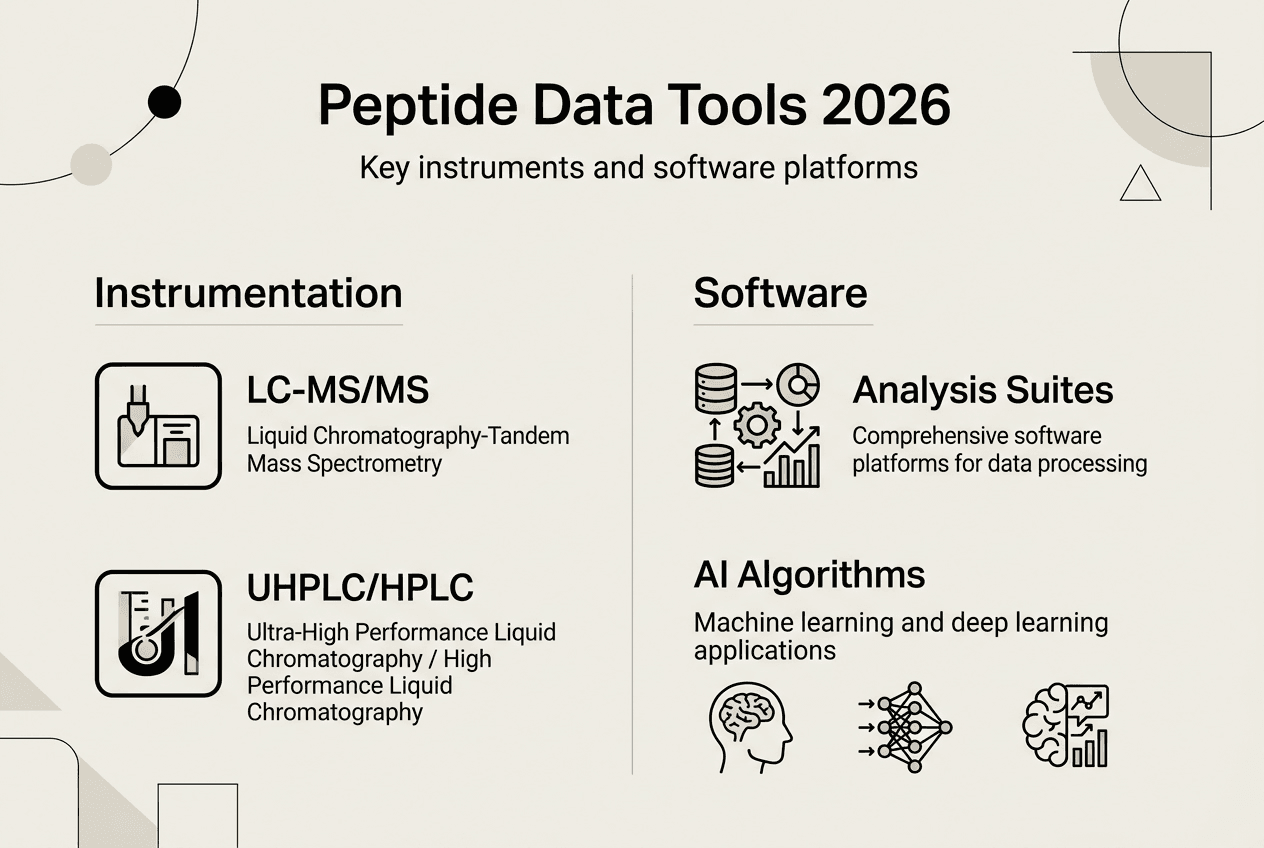
Before analyzing peptide data, you need the right combination of instrumentation, software platforms, and foundational knowledge. Recent technological advances have markedly increased sensitivity, enabling single-cell proteomics and spatial tissue profiling that were impossible just years ago. Your analytical setup should center on liquid chromatography coupled with tandem mass spectrometry (LC-MS/MS), which remains the gold standard for peptide identification and quantification.
UHPLC and HPLC systems provide the separation power necessary to resolve complex peptide mixtures. These instruments must maintain precise temperature control and deliver consistent flow rates to generate reliable retention times. Nuclear magnetic resonance (NMR) spectroscopy serves as a complementary technique for structural validation, particularly when confirming peptide conformation or detecting unusual modifications. Investing in high-quality research peptides ensures your reference standards match the purity levels required for accurate calibration.
Software tools transform raw instrument data into interpretable results. Chromatogram analysis platforms visualize peak shapes, integrate areas, and calculate signal-to-noise ratios. Understanding chromatograms, particularly extracted ion chromatograms, is essential for accurate quantitative proteomics because these focused views isolate specific mass-to-charge ratios from complex mixtures. De novo sequencing software applies algorithms to match fragmentation patterns against theoretical models, while database search engines compare experimental spectra to known peptide sequences.
Your theoretical foundation should include mass spectrometry principles, peptide fragmentation chemistry, and chromatographic retention behavior. Sample preparation protocols directly impact data quality, so establish standardized methods for protein digestion, desalting, and concentration. Quality control measures like retention time standards and internal reference peptides help you detect instrumental drift before it compromises experimental outcomes.
| Tool Type | Primary Purpose | Typical Accuracy |
|---|---|---|
| LC-MS/MS | Peptide identification and quantification | 95-99% sequence coverage |
| UHPLC/HPLC | High-resolution chromatographic separation | Sub-minute retention precision |
| NMR Spectroscopy | Structural confirmation and conformational analysis | Atomic-level resolution |
| De novo software | Novel peptide sequencing without databases | 85-95% amino acid accuracy |
| Spectral libraries | Targeted assay development and validation | 98% identification confidence |
Pro Tip: Maintain thermal stability across your entire UHPLC/HPLC system by ensuring all components from injector to detector remain within the heated zone, preventing retention drift that can invalidate quantitative comparisons across sample batches.
Executing peptide data analysis: step-by-step methods and AI integration
Executing robust peptide data analysis requires systematic workflows that balance throughput with analytical depth. Data-dependent acquisition (DDA) remains widely used for discovery proteomics, where the mass spectrometer selects the most abundant ions for fragmentation in real time. SWATH-MS and other data-independent acquisition (DIA) methods fragment all detectable ions within defined mass windows, generating comprehensive datasets that support retrospective analysis without reacquiring samples.
Peptide-centric scoring algorithms evaluate spectral matches by comparing experimental fragmentation patterns to theoretical predictions or spectral libraries. These approaches assign confidence scores that help you distinguish true identifications from random matches. Spectral libraries compiled from previous experiments or generated in silico provide reference fingerprints that accelerate identification and improve quantitative precision. Building high-quality libraries specific to your experimental system reduces false discovery rates and enhances reproducibility.
Integrating artificial intelligence into proteomics accelerates data analysis and biological interpretation by learning complex patterns human analysts might miss. AI models predict peptide properties like retention time, fragmentation behavior, and ionization efficiency based on sequence composition and modifications. These predictions enable you to validate experimental observations, detect outliers, and optimize separation conditions before running expensive samples.

De novo peptide sequencing algorithms have evolved to use deep learning, improving sequence coverage and accuracy beyond traditional rule-based methods. Neural networks trained on millions of annotated spectra recognize subtle fragmentation patterns that indicate specific amino acid compositions, modifications, or sequence permutations. This capability proves invaluable when studying non-model organisms, antibody sequences, or samples containing unexpected post-translational modifications.
The combination of AI models enables in silico generation of spectral libraries for targeted assays, reducing the need for synthesized reference peptides. You can design parallel reaction monitoring (PRM) or selected reaction monitoring (SRM) experiments based entirely on computational predictions, then validate performance with experimental data. This workflow dramatically accelerates assay development for novel peptides like retatrutide or other emerging research compounds.
| Method | Identification Approach | Accuracy | Computational Load |
|---|---|---|---|
| Traditional database search | Match spectra to known sequences | 90-95% | Low to moderate |
| Rule-based de novo | Apply fragmentation rules manually | 75-85% | Moderate |
| Deep learning de novo | Neural network pattern recognition | 92-97% | High |
| AI-predicted spectral libraries | In silico fragmentation modeling | 94-98% | Moderate to high |
- Import raw mass spectrometry files into your analysis platform and perform quality checks on total ion current and base peak intensity.
- Select appropriate search parameters including mass tolerance, enzyme specificity, and variable modifications relevant to your experimental design.
- Apply AI retention time prediction models to validate observed elution patterns and flag potential misidentifications.
- Generate or import spectral libraries matching your acquisition method and instrument configuration.
- Execute database searches or de novo sequencing with false discovery rate thresholds appropriate for your application.
- Integrate AI fragmentation predictions to verify ambiguous spectral assignments and improve confidence scores.
- Export quantitative results and perform statistical validation using the peptide research tools calculator or similar platforms.
Pro Tip: When selecting AI tools for peptide analysis, prioritize models trained on data from instruments similar to yours, as fragmentation behavior varies between collision-induced dissociation, higher-energy collisional dissociation, and electron-transfer dissociation methods.
Verification and troubleshooting: common pitfalls and data quality assurance
Even well-designed experiments encounter analytical challenges that compromise data quality if left unaddressed. Retention drift in peptide analysis is mainly caused by temperature fluctuations, impacting retention time consistency across analytical runs. Monitor your column oven temperature with external sensors and verify that heated zones encompass the entire flow path from pump to detector. Small temperature variations of just 2-3 degrees Celsius can shift retention times enough to invalidate scheduled targeted assays.
Ion-pair reagent depletion can cause signal suppression and baseline drift, affecting peptide data reliability in reversed-phase separations. Trifluoroacetic acid and other ion-pairing agents gradually deplete from mobile phase reservoirs through evaporation or degradation, altering selectivity and peak shape. Replace mobile phases regularly and store them in sealed containers to maintain consistent composition throughout multi-day analytical sequences.
Chromatogram interpretation mistakes often stem from misidentifying shoulder peaks, failing to recognize co-eluting interferences, or overlooking baseline disturbances that skew integration. Always inspect extracted ion chromatograms at multiple mass extraction windows to confirm peak purity. Compare retention times against quality control standards run at regular intervals. When analyzing peptides like semaglutide, verify that observed retention behavior matches expected hydrophobicity based on sequence composition.
Data quality assurance extends beyond individual runs to encompass entire experimental campaigns. Establish acceptance criteria for retention time precision, peak symmetry, signal intensity, and mass accuracy before beginning sample analysis. Document any deviations and implement corrective actions immediately rather than attempting post-hoc corrections that introduce additional uncertainty. Reproducible results require reproducible method conditions, from sample preparation through data processing.
- Verify column temperature stability by monitoring actual temperature versus setpoint throughout analytical runs.
- Check mobile phase composition weekly using refractive index measurements or pH monitoring.
- Inspect system pressure traces for irregularities indicating partial blockages or pump seal wear.
- Validate mass calibration daily using manufacturer-recommended calibration mixtures.
- Compare retention times of quality control peptides against established acceptance windows.
- Review integration parameters to ensure consistent peak detection across all samples.
- Archive raw data files immediately after acquisition to prevent accidental overwriting or corruption.
Consistent method conditions form the foundation of reproducible peptide analysis. Small variations in temperature, mobile phase composition, or instrument tuning compound across analytical sequences, transforming minor deviations into systematic errors that undermine experimental conclusions.
Pro Tip: Monitor ion-pair reagent stability by tracking retention time and peak shape for a simple test peptide analyzed at the start of each analytical sequence, replacing mobile phases whenever retention shifts exceed 0.5% of the expected value.
Enhance your research with high-quality peptides and tools
Accurate peptide data interpretation starts with reliable reference materials and research-grade compounds that meet the purity standards your experiments demand. NexaPeptide provides high-quality peptides including retatrutide and semaglutide specifically formulated for laboratory applications requiring consistent composition and documented purity.
Our catalog supports diverse research needs from method development to validation studies, with transparent specifications that enable confident experimental design. Access precision research peptides calculator and supplies to optimize reconstitution protocols and ensure accurate concentration determination. When your data quality depends on peptide integrity, choosing verified research-grade materials eliminates a critical source of analytical variability and strengthens the reproducibility of your findings.
Frequently asked questions
What is the role of artificial intelligence in peptide data interpretation?
AI accelerates peptide property prediction, spectral library generation, and enhances sequencing accuracy, enabling faster and more reliable data interpretation. Machine learning models identify complex patterns in fragmentation spectra that traditional algorithms miss, improving identification of novel peptides and post-translational modifications. These tools integrate seamlessly with existing workflows to reduce manual curation time while increasing confidence in analytical results.
How can I avoid retention time drift during peptide analysis?
Maintain strict thermal control throughout UHPLC/HPLC systems to prevent temperature fluctuations that cause retention shifts. Ensure all system components from injector valve to detector cell remain within the heated zone and verify actual temperatures match setpoints. Monitor retention times of quality control standards and replace mobile phases regularly to prevent composition changes from evaporation or degradation.
What are the advantages of de novo peptide sequencing methods?
De novo sequencing allows identification of novel peptides, mutations, and modifications not present in protein databases. Advanced algorithms using deep learning provide higher accuracy and sequence coverage than traditional methods by recognizing subtle fragmentation patterns. This capability proves essential when studying non-model organisms, antibody therapeutics, or samples containing unexpected chemical modifications that database searches would miss.
How do I select appropriate mass tolerance settings for database searches?
Mass tolerance settings should reflect your instrument’s actual mass accuracy under typical operating conditions. High-resolution instruments like Orbitrap or TOF systems typically use 5-10 ppm precursor tolerance and 0.01-0.02 Da fragment tolerance, while lower-resolution ion traps require wider windows of 0.5-1.0 Da. Verify mass accuracy using calibration standards before each analytical session and tighten tolerances to reduce false positive identifications while ensuring true matches remain captured.
What quality control metrics should I monitor during peptide analysis?
Track retention time precision for quality control peptides, typically requiring coefficients of variation below 1-2%. Monitor peak symmetry factors to detect column degradation or system contamination early. Verify mass accuracy remains within specification and assess signal intensity stability across analytical sequences. Document system pressure trends and baseline noise levels to identify developing problems before they compromise sample data.
Recommended
- retatrutide 5mg - 60mg Peptide – Research Grade 99.75%| NexaPeptide
- Semaglutide 2mg - 50mg Peptide – Research Grade Purtiy 99.67% | NexaPe – NexaPeptide
- Cagrilintide 5mg - 10mg Peptide – Research Purity Grade 99.77% | NexaP – NexaPeptide
- Tirzepatide 5mg - 100mg – Research Purity Grade 99.84% | NexaPeptide